
Digital is no longer a separate business initiative for most small and midsize firms. It shapes how they compete, serve clients, protect information, hire people, and make decisions.
For professional services organizations—accounting, legal, financial advisory, consulting, and similar firms—that shift shows up every day. Clients expect faster responses and cleaner digital experiences. Competitors can reach the same markets with leaner teams and more automation. Security risks are rising. Software costs keep climbing. And artificial intelligence adds both real opportunity and a great deal of noise.
The central challenge is not “becoming digital.” It is operating effectively inside a faster, more complex digital business environment without letting technology decisions drift away from business priorities.
Below are seven challenges that define that environment for SMB leaders right now—and a practical way to decide what deserves attention first.
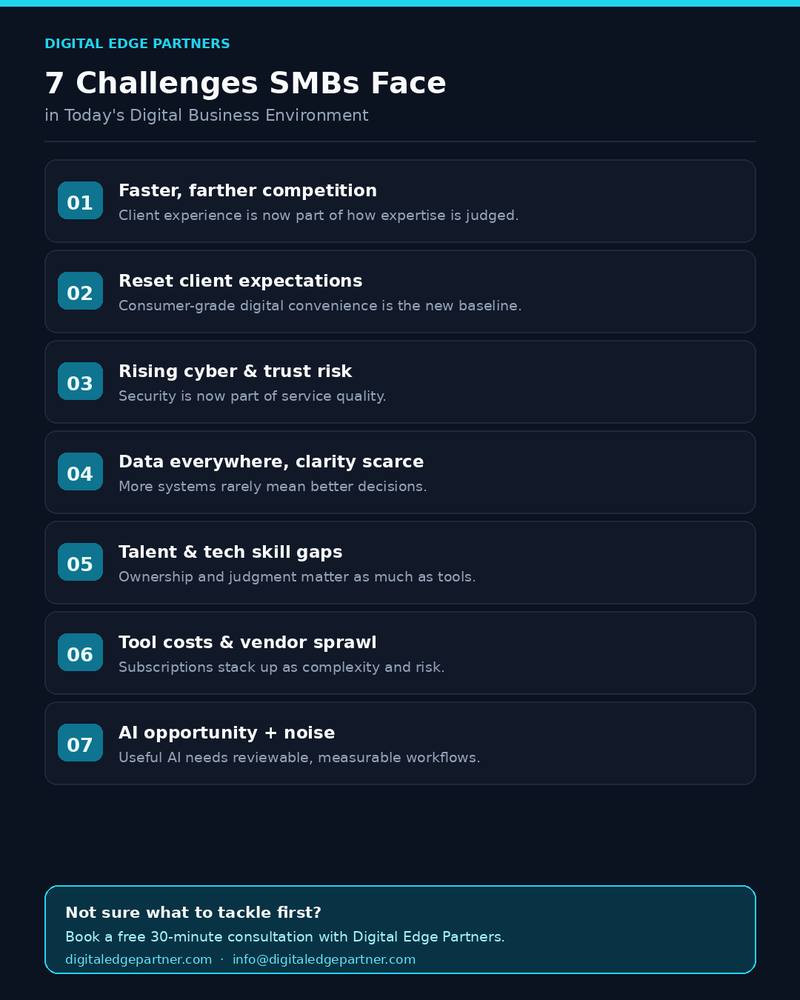
1. Competition Moves Faster and Reaches Farther
SMBs no longer compete only with the firm across town. Cloud platforms, remote delivery, and digital marketing allow competitors of any size to appear professional, responsive, and available.
That changes the competitive baseline. Prospects compare websites, response times, client portals, and digital convenience as part of evaluating expertise. A firm with strong professionals but weak digital delivery can lose work to a smaller competitor that simply makes engagement easier.
Day to day, this shows up as pressure to match capabilities that once belonged only to larger organizations: online intake, secure file exchange, clearer service packaging, and faster turnaround.
Competitive pressure in a digital environment is often less about flashy technology and more about whether the client experience feels modern and reliable.
2. Client Expectations Have Reset
Clients bring consumer-grade digital expectations into professional relationships. They want status without chasing email threads. They expect secure ways to share sensitive documents. They notice when communication feels slow or fragmented.
For professional services firms, this is not a branding issue alone. It affects trust, retention, and referral quality. When onboarding is clumsy or updates are hard to find, clients may question operational discipline even when the advice itself is strong.
Common friction points include: - Intake forms that require rework or duplicate information - Document collection through insecure or inconsistent channels - Limited visibility into project status - Billing and scheduling that feel disconnected from the service experience
Meeting these expectations does not require every enterprise platform. It does require deliberate design of the digital moments that matter most in the client journey.
3. Cybersecurity and Trust Risk Keep Rising

As more work, communication, and records move online, SMBs become more attractive targets. Professional services firms are especially exposed because they hold confidential client information and often operate with lean IT support.
The challenge is not only preventing breaches. It is also maintaining client confidence, insurance readiness, and regulatory posture while teams use a growing mix of cloud tools, personal devices, and AI assistants.
Leaders feel this tension constantly: move faster digitally, but do not create avoidable risk. Shadow IT, weak access controls, shared passwords, and unreviewed vendor security practices can quietly expand the attack surface.
In a digital business environment, security is part of service quality—not a separate technical afterthought.
4. Data Is Everywhere, Clarity Is Not
Most SMBs now generate more data than they can use well. CRMs, billing systems, project tools, email platforms, and marketing software all collect information. Yet leaders still struggle to answer basic questions with confidence:
- Which services are actually profitable?
- Where do delivery delays begin?
- Which clients generate sustainable growth?
- Which operational bottlenecks are costing the most time?
The challenge is not a lack of dashboards. It is fragmented data, inconsistent definitions, and reporting that depends on manual spreadsheets. Teams spend hours assembling numbers that still leave room for argument.
Without clearer information flows, digital investment often adds noise instead of decision support.
5. Talent and Technology Skills Are Harder to Align
Hiring remains difficult for many SMBs, and digital change raises the skill bar further. Firms need people who can deliver client work and also adapt to new systems, automation, and collaboration tools.
At the same time, specialized technology talent is expensive and hard to retain. Many organizations cannot justify a full-time technology leadership role, yet they still need someone who can evaluate vendors, sequence investments, and prevent tool sprawl.
This gap shows up in familiar ways: - Projects stall after software is purchased - Training is incomplete and adoption stays shallow - Key processes depend on one power user - Leadership lacks a trusted translator between business goals and technology options
The skills challenge is as much about judgment and ownership as it is about technical credentials.
6. Tool Costs and Vendor Sprawl Keep Climbing
Subscription software made advanced capabilities accessible—and also made it easy to accumulate overlapping tools. Over time, firms pay for licenses that are underused, integrations that never fully work, and platforms that solve narrow problems while creating new handoffs.
Rising prices compound the issue. What felt affordable as a single purchase becomes expensive as a portfolio. Finance teams see the cost. Operations teams feel the complexity. Neither always has a clear inventory of what is essential.
In a digital business environment, uncontrolled tool growth is not just a budget problem. It slows onboarding, weakens data quality, and increases security exposure.
7. AI Creates Opportunity—and a Lot of Noise
Artificial intelligence is already changing parts of professional work: research support, document drafting, summarization, and internal knowledge retrieval. The challenge for SMB leaders is separating practical use cases from hype.
Vendors promise transformation. Teams experiment unevenly. Compliance and confidentiality questions appear quickly. Without a clear stance, firms risk either falling behind peers who use AI carefully—or introducing tools that create more risk than value.
A useful framing is straightforward: AI should improve specific workflows where quality can be reviewed, risk can be managed, and time savings are measurable. It should not become a substitute for strategy, process discipline, or professional judgment.
How Leaders Can Prioritize Without Boiling the Ocean

These challenges arrive together, which is why many SMBs feel permanently behind. The response is not to tackle everything at once. It is to prioritize based on business impact.
A practical sequence looks like this:
- Identify which pressures are affecting growth, client trust, delivery quality, profitability, or resilience right now.
- Separate symptoms (too many tools, slow response times) from causes (unclear ownership, broken handoffs, missing standards).
- Choose a small number of high-leverage improvements that reduce friction in a real workflow.
- Make security and data handling part of every change, not a later cleanup step.
- Assign clear ownership—internal or fractional—so decisions do not stall between “everyone” and “no one.”
This approach keeps technology investments connected to operating reality. It also prevents the common cycle of buying another platform whenever a new pressure appears.
If that prioritization feels hard to do from inside the business, that is common. An outside perspective can help you separate urgent noise from the few changes that will actually improve how the firm operates.
Ready to pressure-test your priorities? Schedule a free 30-minute consultation with Digital Edge Partners and we will help you identify which digital challenges matter most for your firm right now—and what practical next steps make sense. Reach us at info@digitaledgepartner.com or through our contact page at https://digitaledgepartner.com.
Looking Ahead
The digital business environment for SMBs will keep changing. Client expectations will rise. Security threats will evolve. AI capabilities will expand. Tool markets will keep marketing urgency.
Firms that navigate this well will not necessarily adopt the most tools. They will build the ability to read the environment clearly, prioritize deliberately, and improve operations without losing trust, quality, or focus.
That capability—more than any single platform—is what turns digital pressure into durable advantage.
Talk With Digital Edge Partners
If your firm is feeling several of these pressures at once, you do not need another generic technology recommendation. You need a clear read on what to tackle first—and a practical path to do it without disrupting client delivery.
Digital Edge Partners helps professional services SMBs navigate digital transformation with enterprise-grade strategy and execution, without enterprise overhead. Whether you need fractional technology leadership, help modernizing operations, or a grounded AI and automation roadmap, we will meet you where you are.
Next step: Book your free 30-minute strategy call. Tell us what is creating the most pressure in your environment, and we will discuss how we can help.
- Schedule a consultation: https://digitaledgepartner.com
- Email: info@digitaledgepartner.com
We look forward to the conversation.